
Being active in the crypto community means signing up for a lot of things that have nothing to do with your money. Newsletters, community chats, alert bots, meetup registrations, hackathon forms and governance forums all ask for a phone number sooner or later. For those sign-ups, an smsfast temporary number can receive the code, so your personal number is not stored by every project, organizer and tool you meet along the way. Your exchange accounts, on the other hand, need the opposite approach, and this guide explains why.
Why your number travels further than your wallet address
Most crypto users think hard about wallet hygiene: hardware devices, seed backups, separate wallets for testing. Phone numbers get far less attention, even though they connect your identity across services much more reliably than a wallet address does.
A single number used for an exchange, three community chats and a dozen newsletters links all of those profiles together. If any one of those services leaks its user list, the number becomes a bridge between your public community activity and your financial accounts. Keeping the two apart is a simple way to limit what anyone can piece together.
The privacy principle behind it
European data protection law already points in this direction. The General Data Protection Regulation (GDPR), which has applied since May 25, 2018, sets data minimisation as a core principle in Article 5. Personal data should be adequate, relevant and limited to what is necessary for the purpose.
Many community tools still ask for more than they need. A newsletter rarely requires a phone at all, and an event form usually needs only a way to send you a ticket. When a service insists on a number it does not really need, you can apply the same principle yourself and share a separate one.
Which crypto sign-ups get which number
Sort every crypto-related account by one question: does it hold funds or verify your identity? If yes, it gets your real number. If no, it does not need it.
| Account or form | Holds funds or verifies identity? | Which number |
| Centralized exchange | Yes, KYC and withdrawals | Your own SIM number |
| Custodial wallet or crypto card | Yes, balances and payments | Your own SIM number |
| Newsletter or research subscription | No | Temporary number, or none |
| Price alert or community bot | No | Temporary number |
| Meetup, conference or hackathon registration | No, only a ticket | Temporary number |
| Community chat app you use daily | No, but you need long-term access | Long-term rented number |
| Governance or DAO forum | No, but your reputation lives there | Long-term rented number |
Anything you will log into for years needs a number you will still control in years. A temporary number fits one-off forms; a rented number fits communities you plan to stay in.
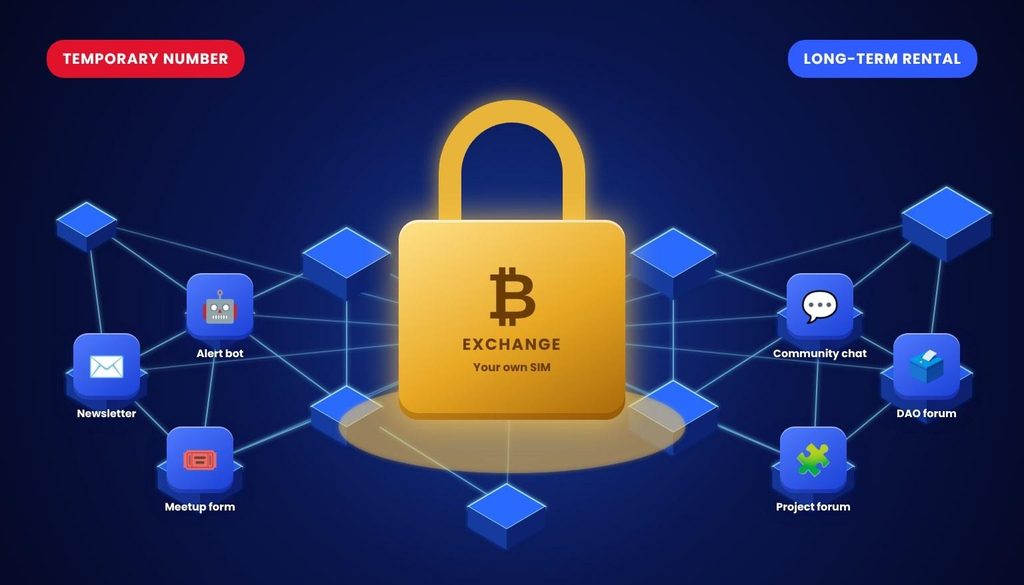
Exchanges are the exception
Crypto-asset service providers in the EU must know who their customers are. The Transfer of Funds Regulation (EU) 2023/1113, together with EBA Travel Rule guidelines applicable from December 30, 2024, requires providers to send originator and beneficiary information with crypto transfers. Your exchange account is tied to your identity by law, so its contact details should be stable and yours.
Never register an exchange, custodial wallet or crypto card with a temporary number. Withdrawal confirmations, security alerts and account recovery all depend on that number. If it expires, you lose the channel that protects your funds.
A five-minute cleanup routine
Most community members already have their number in more places than they remember. A quick audit fixes that.
1. List every crypto newsletter, bot, chat and forum you joined in the last year.
2. Mark the accounts that hold funds or required identity checks, and leave them on your SIM.
3. Unsubscribe from newsletters and tools you no longer read, and delete those accounts.
4. Move the communities you keep to a long-term rented number when the platform allows a number change.
5. Use a temporary number for every new one-off form from now on.
Services such as SMSFAST offer numbers in 190+ countries, with activations of 20 to 90 minutes for one-off forms and rentals from one day to one year for communities you stay in.
Warning signs in community sign-up forms
A separate number limits exposure, but it does not replace caution. Stop and check before submitting a form that shows any of these signs:
- it asks for your seed phrase or private key, which no legitimate project ever needs;
- it combines a phone number, wallet connection and “claim now” timer on an unfamiliar domain;
- it arrives through a direct message instead of the project’s official channel;
- it requests identity documents for a free event or a newsletter.
When in doubt, open the project’s official website yourself and find the form from there.
Honest limits
Some community apps reject virtual numbers and ask for a carrier number. Decide whether the community is worth your real number, or follow it through a channel that does not need one. Temporary numbers also expire quickly, so do not use them for anything you will need to log back into.
Finally, airdrops and community rewards usually allow one claim per person. Use a separate number to protect your privacy, not to register extra accounts for additional allocations.
The bottom line
Your phone number is part of your crypto security, even when it never touches a wallet. Keep exchanges, custodial wallets and cards on your own SIM. Give newsletters, bots and event forms a temporary number, and put long-term communities on a rented one. Your public crypto life and your financial accounts stay separate, which is exactly what good privacy hygiene is for.